How much does a business website cost? Compare quotes fairly
Neaptide · September 7, 2026 · 7 min read · Updated: October 4, 2026
Website costs: Neaptide’s published starting prices, deliverables, recurring costs and a template for comparing actual quotes.
On this page

A quote’s price only makes sense with its scope. Establish who writes copy, connects the CRM, configures analytics and trains the editor. Compare totals for the same agreed work and request missing charges separately.
A website budget covers development, content, connected services and ongoing operation. There is no universal price for a “turnkey website”, nor a standard list of what it includes, and the same page count can hide very different amounts of work. So send each agency the same brief, and ask them to show included work, exclusions and recurring charges separately.
Define the job before requesting a price
Start by describing the outcome your business needs. For example: a visitor chooses a service and submits an enquiry, the sales team receives it in the CRM with its source, and an employee can update the service description without calling a developer. That gives an agency something specific to estimate, and gives you something to check the finished work against.
- Pages and templates. Ten pages using one layout are a different job from ten unique designs, so list the pages and mark the sections that repeat.
- Content. Who writes the copy, supplies photography, migrates existing material and approves translations? Specify quantities, languages and owners.
- Features. For an enquiry form, define the fields, validation, destination and failure behaviour. “CRM integration” on its own tells an agency very little.
- Editing and handover. Say what your staff must be able to change on their own, and which accounts, source files and instructions you expect to receive.
- Launch. This covers domain work, redirects from old URLs, analytics, scenario testing and fixing the defects found during acceptance. Ask which of these the price includes.
Real starting prices: what can be compared
Neaptide’s web development page lists the starting prices below, checked against the site’s current content on 3 October 2026. These are the studio’s published indications for different project types. Scope, taxes and the final amount belong in the proposal; these are not three bids for identical work.
| Project type | Starting price | Meaning |
|---|---|---|
| Landing page | US$2,900 | One project format; final quote follows scoping |
| Corporate website | US$8,200 | A different project type, not equivalent to a landing page |
| Web application | US$14,000 | Application with an agreed feature set |
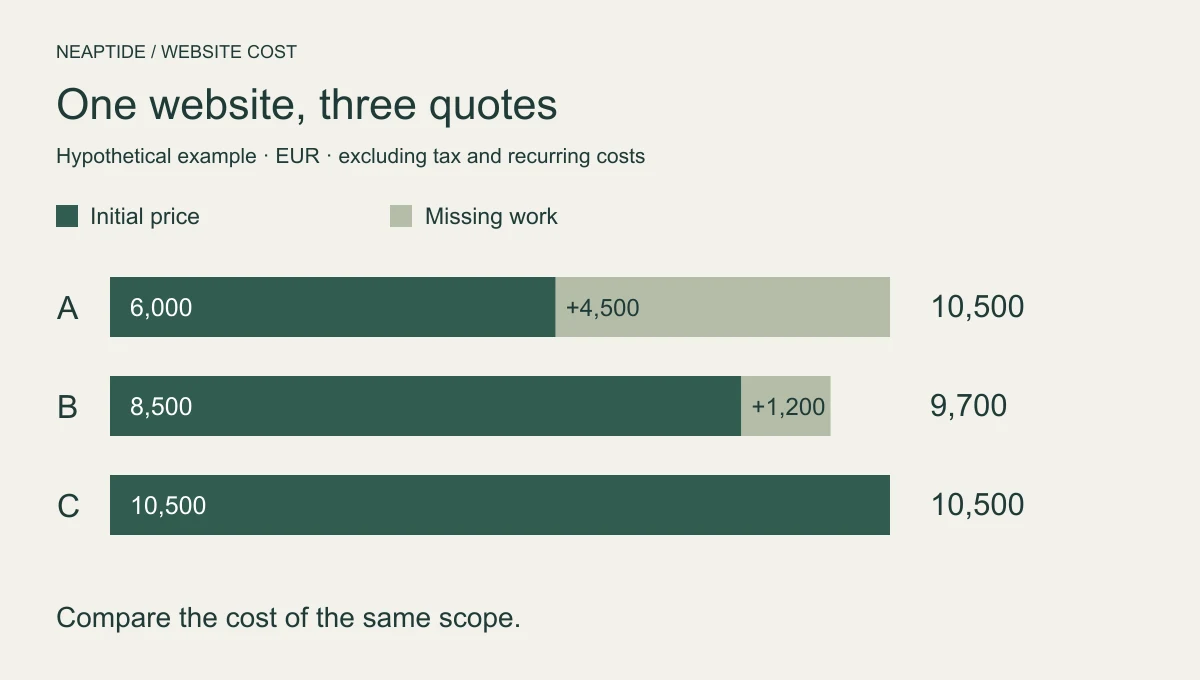
These prices do not identify a cheapest supplier: there is one supplier and three different project types. To compare suppliers, populate the template below with actual proposals and price every missing item.
An unknown extra is not zero, so do not enter it as zero. Ask for an estimate, or a range with clear conditions for refining it. If your team supplies the copy, record their time separately. No supplier will invoice you for those hours, but your staff will still spend them.
Budget for the months after launch
Keep the one-off launch cost apart from the next 12 months of operation. Running costs may include the domain, hosting or a platform subscription, paid apps, email, maintenance and content updates. For each item, record the billing period, currency, limits and who pays. Multiplying every price by 12 will not work, because some charges are annual and others depend on usage.
Shopify, for example, distinguishes app subscriptions, usage charges and one-time purchases. Some apps bill outside Shopify. So a single line reading “platform subscription” will not show you what the store really costs to run.
Agree how the finished website will be checked
- “The form works”: submit a test enquiry and find it in the CRM, then see what happens on a failure and a retry. Agree in advance who handles problems on the integration side.
- “Easy CMS”: have a member of your team try changing a service description, an image and the page title and description used in search results. Check whether instructions and training are included.
- “Fast website”: agree which pages are tested, on which devices and under what conditions. One impressive score does not describe the whole user experience.
- “SEO included”: ask for the actual deliverables. They might be editable metadata, a sitemap, indexing controls and redirects where old URLs change.
web.dev distinguishes lab tests from real-user data. Lab tests are what you use before launch, while field data shows what happens on visitors’ own devices and connections. A strong Lighthouse score is one useful test result. It does not promise the same speed for every visitor.
Technical search preparation is not a ranking guarantee. Google explicitly warns that nobody can guarantee a number-one ranking. Look for a quote that lists the SEO work and how it will be checked, and be wary of one that simply promises a top position.
Fixed price or time and materials?
A fixed price is easier to compare once you have agreed the work, the number of revision rounds and how the finished site will be checked. Sometimes an integration needs investigating first. In that case, commission a separate discovery stage with a clear deliverable. For hourly work, ask for rates, time records, a budget for each stage and a way to approve extra spending. Either way, agree which changes count as additional work.
If the quote is over budget, trim the first release. A second language or a customer portal can wait, provided the main journey works without it. Write down what is deferred and ask what it would cost to add later. What you should not do is quietly remove a necessary step in handling enquiries just to lower the headline figure.
Neaptide’s published starting prices
The table uses Neaptide’s service page. A firm quote follows agreement on pages, features, content and acceptance criteria. The link below lets you check the current terms.
For a useful estimate, share the page list, available content, required integrations and target launch date, and say what your own team will supply. The fewer assumptions an agency has to make, the fewer of them turn into extra charges later.
A worksheet for comparing quotes
Download the Markdown worksheet and copy the table into your working document. Fill in one column per quote, and where something is unclear, write “not confirmed”. Then ask each agency the same questions and update the totals.