Next.js SEO Release Checklist: Eight Tested Defects
Neaptide · October 13, 2026 · 9 min read
We injected eight defects into a Next.js fixture. A small HTTP checker caught six and missed two. Download the script, results and repeatable test.
On this page
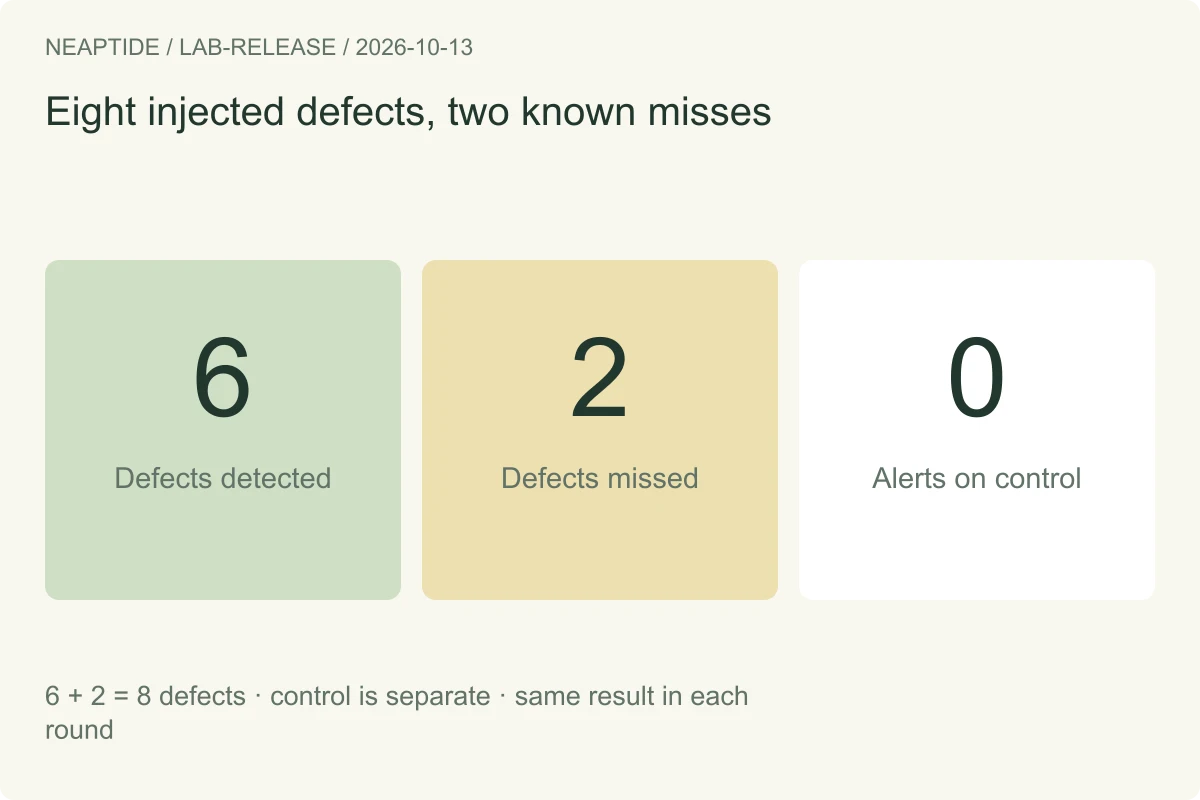
A passing SEO release check only covers what the check can observe. On October 13, 2026, we tested a small response-HTML checker against eight deliberately injected defects in a Next.js production build. It detected six and missed two in each of two rounds. The clean control produced no alerts. The two misses explain why a release checklist also needs robots.txt and browser checks.
One control, eight defects, two rounds
We adapted the fixtures from our earlier canonical, hreflang and sitemap experiments. Each of nine scenarios had English and French product pages; each defective scenario introduced one problem. We froze the scenario list, source files, expected values and checker before requesting the pages. This was a local synthetic experiment on Next.js 15.5.22 and React 19.2.6, not an audit of nine websites.
The script checks response status, one expected canonical, generic noindex directives, a nonempty title, an H1 in response HTML, an exact hreflang map and one sitemap’s listed URLs. Title and H1 checks are explicit project contracts, not claims about universal Google indexing requirements. Expectations come from a reviewed manifest. Reading them from the page being tested would risk accepting the same mistake twice.
What the checker detected and missed
| Case / injected condition | Result in both rounds | Reported signal |
|---|---|---|
| C00 · Clean control | No alert | None |
| D01 · Canonical points to the wrong domain | Detected | CANONICAL |
| D02 · Robots meta contains noindex | Detected | NOINDEX |
| D03 · French hreflang points to a missing route | Detected | HREFLANG |
| D04 · Sitemap lists an extra 404 URL | Detected | SITEMAP_TARGET_STATUS |
| D05 · English page has no title | Detected | TITLE |
| D06 · robots.txt disallows the scenario | Missed | None |
| D07 · Product content disappears after hydration | Missed | None |
| D08 · HTTP X-Robots-Tag contains noindex | Detected | NOINDEX |

The original experiment comprised 18 checker runs and 56 HTTP responses. All findings matched between rounds. We then extracted the downloadable archive, installed its pinned dependencies and built it separately: all check values matched across another 18 runs. These repeats test reproducibility; they do not turn eight selected defects into a representative detection-rate benchmark. The same agent designed the checker, fixtures and review.
Why a green report can still accompany a broken page
In D07, the response contained the product heading and content. After JavaScript ran, the browser showed only a message saying the product content had been removed. The checker’s H1 test passed because it parsed the response and never executed JavaScript. A browser observation confirmed the missing content; this was not a Googlebot rendering test.

In D06, the root robots.txt contained a rule disallowing the scenario. Ordinary GET requests still returned valid pages, and the checker did not parse robots.txt. It therefore passed this case too. Google documents crawling controls, indexing directives and rendering separately. An HTTP 200 and an absence of noindex do not establish that Google can crawl, render or index the intended content.
Run the same check and read the report
Download and extract the full test bundle. In its fixture directory, run npm ci --ignore-scripts, npm run build and npm run start. Keep that terminal running. From the extracted bundle’s root, use the command below. Python 3.9 or later is sufficient for the checker; it has no third-party Python dependencies. The README records the exact tested runtime versions.
python3 check_release.py \
  --origin http://127.0.0.1:8792 \
  --manifest manifests/control.json \
  --out control-check
Exit 0 means no covered contract failed; exit 1 means findings; exit 2 means an input or run error. Use a new output directory for each run. Replacing control.json with canonical.json produces the recorded canonical failure. For both complete rounds, run python3 collect.py and then python3 analyze.py from a fresh extraction.
This excerpt is derived from the actual D01 report. The complete report also records passed checks, response evidence and unchecked areas.
{
  "passed": false,
  "findings": [
    {
      "code": "CANONICAL",
      "url": "http://127.0.0.1:8792/canonical/en/product",
      "passed": false,
      "observed": [
        "https://wrong.example/product"
      ],
      "expected": [
        "http://127.0.0.1:8792/canonical/en/product"
      ]
    }
  ]
}
For your site, replace the sample manifest with a reviewed set of important routes and expected values. The script only requests the supplied origin, follows no redirects and supports one sitemap urlset, up to 100 explicit pages and 30 sitemap locations. It does not validate translation quality or all hreflang relationships. Complex user-agent-specific X-Robots syntax, sitemap indexes and browser behavior are outside its validated scope.
A release workflow beyond this script
Use the report as one evidence file in a release decision. The table below is our proposed workflow, not an experimentally validated release policy. Staging may intentionally use authentication or noindex. Review expectations for each environment; do not remove those protections merely to make a check pass.
| Stage | Owner / check | Evidence to retain |
|---|---|---|
| Before release | Developer and SEO owner review expected routes, canonical URLs and available translations | Versioned manifest; known exclusions; comparison with the previous build |
| Release candidate | Run HTTP checks, separately review robots rules and inspect important pages after JavaScript | JSON report; robots review; browser evidence of content and links |
| After deployment | Repeat against public routes; investigate changes in Search Console and analytics when access is available | Public response/render checks; actual indexing and performance data with dates |
Script, fixture and research data
- Complete test bundle and README · ZIP (English)
- Standalone checker · Python
- Protocol, observations and analysis · JSON (English)
- Nine-case result matrix · CSV (English)
- Recorded D01 report · JSON (English)
- Instructions and limitations · TXT (English)
This hand-selected lab does not establish a real-world detection rate, a complete SEO audit or prevention of traffic loss. A silent control is evidence about this control only. We measured no Google indexing, rankings, leads or AI citations. Search demand for the topic was not quantified. Our conclusion is limited to the supplied checker version and fixtures.
The fixture preserves older pinned dependencies for reproduction. Its fresh installation reported three dependency advisories. Keep it on loopback as documented; it is not a production starter. Review current dependency advisories before adapting the code.