B2B Catalog Filter SEO: A 20-Case Study
Neaptide · October 13, 2026 · 9 min read
We tested 20 bottle-catalog selections twice. Compare full product sets, URL behavior and a decision matrix for choosing which filters deserve search pages.
On this page
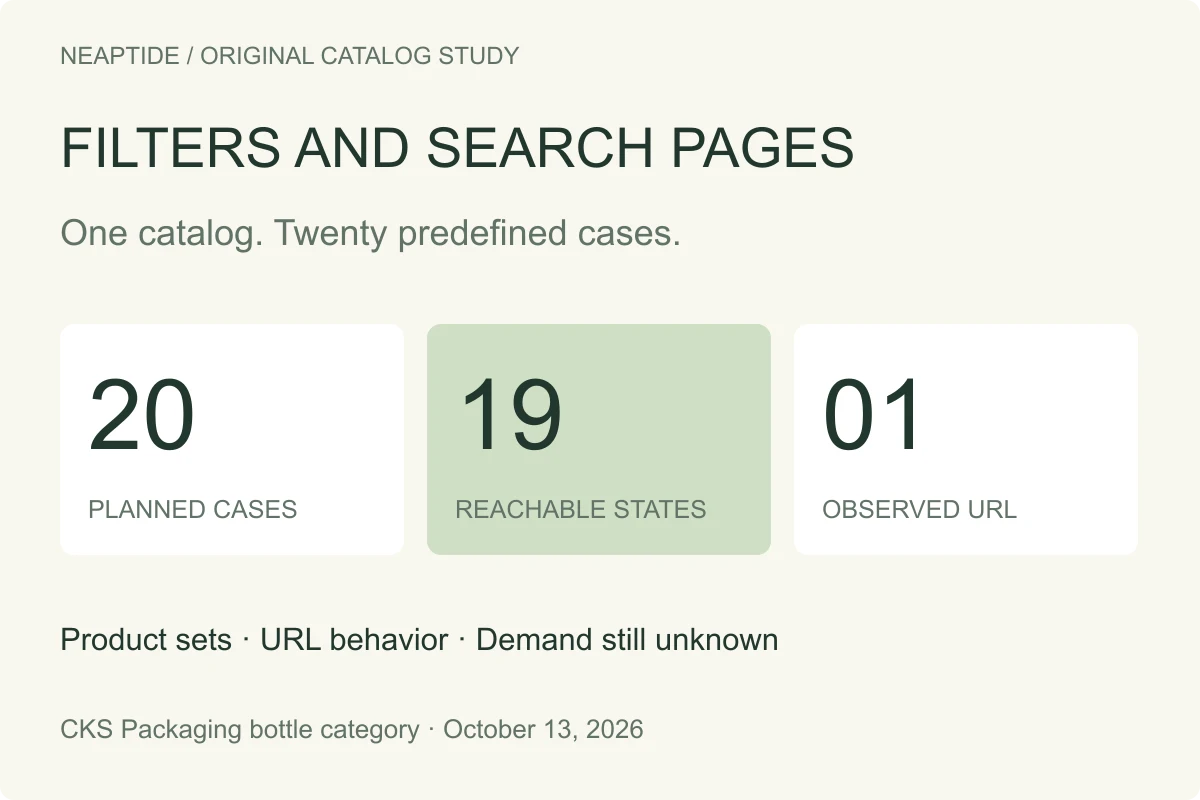
A useful filter can help a buyer without creating a separate page for search. To see where that distinction matters, we tested 20 predefined selections in CKS Packaging’s public bottle catalog on October 13, 2026. Nineteen were reachable, including the unfiltered baseline; the twentieth was disabled. The 18 filtered selections produced distinct, nonempty product sets, while the browser stayed on one category URL.
Our recommendation is to validate a buying need and search demand before creating a dedicated landing page. Product count is insufficient. In this study, two selections with 56 products shared only 21 of them. No demand data was available, so the matrix below identifies research candidates rather than approved pages to index.
What we selected and how we checked it
We chose one English-language category from a US manufacturer already included in our earlier B2B catalog study. This is new category-level evidence from one business, not another independent market sample. Before applying filters, we fixed the baseline, six materials, two shapes, two markets, eight two-filter combinations and one three-filter combination. The catalog describes its public list as partial; these are listed products, not confirmed stock.
The product list is virtualized: a single screen’s DOM contains only part of the catalog. We accumulated product URLs while scrolling and checked that the unique URL count matched the displayed total. Both completed rounds covered all 19 reachable sets: 38 complete set captures. One researcher performed the collection and repeat check. Early incomplete scrolling probes were excluded and retained in the research log.
The complete selection map
Counts and full product URL sets matched in both rounds. Filter names below reproduce the interface labels. Food and Industrial are category labels, not independently verified suitability or certifications. All 19 reachable cases used /catalog/bottles; the filter controls supplied no links to separate filtered URLs.
| Selection in the interface | Listed products | Demand / search-page decision |
|---|---|---|
| F00 · Bottles only · baseline | 213 | Existing category; indexing unknown |
| F01 · HDPE | 128 | Validate demand and purpose first |
| F02 · PET | 59 | Validate demand and purpose first |
| F03 · PETG | 9 | Validate demand and purpose first |
| F04 · Plastic | 2 | Validate demand and purpose first |
| F05 · PP | 4 | Validate demand and purpose first |
| F06 · PVC | 14 | Validate demand and purpose first |
| F07 · Round | 83 | Validate demand and purpose first |
| F08 · Square | 30 | Validate demand and purpose first |
| F09 · Food | 47 | Validate demand and purpose first |
| F10 · Industrial | 56 | Validate demand and purpose first |
| F11 · HDPE + Round | 56 | Validate demand and purpose first |
| F12 · PET + Round | 25 | Validate demand and purpose first |
| F13 · HDPE + Square | 15 | Validate demand and purpose first |
| F14 · PET + Square | 13 | Validate demand and purpose first |
| F15 · Food + HDPE | 14 | Validate demand and purpose first |
| F16 · Food + PET | 23 | Validate demand and purpose first |
| F17 · Industrial + HDPE | 49 | Validate demand and purpose first |
| F18 · Industrial + PET | 7 | Validate demand and purpose first |
| F19 · Industrial + PET + Square | Unavailable; not measured as zero | Do not create from this observation |
Equal counts can hide different product sets
Industrial returned 56 products. HDPE + Round also returned 56, but only 21 product URLs appeared in both sets: each selection had 35 products absent from the other. A second comparison was more clear-cut: PVC and Food + HDPE each returned 14 products, with no URLs in common. Grouping filter pages by count would miss these differences.

Even identical product sets would still require an intent and content review before treating two pages as duplicates. Google’s canonical guidance concerns duplicate or very similar content; equal counts alone establish neither. The six material counts also add up to 216 selections but cover 213 unique product URLs, so those counts cannot be added as independent inventory.
The URL test changes the next step
None of the 18 reachable filtered selections changed the browser URL. Reloading HDPE, PET + Round and Food + HDPE reset each to the 213-product Bottles baseline. Those three tests show that the observed category URL did not reproduce those selections on a fresh load. Creating a search page for one would therefore require a deliberate route and content decision.
Industrial + PET could be selected and showed seven products. Adding Square was disabled in both rounds, so the planned three-way state was never reached. We did not label it an empty page, assign it an HTTP status or invent a filtered URL. Its planned reload test could not run; three of four planned reload tests were completed.
The category returned HTTP 200 in two ordinary requests. We observed no canonical element or robots meta tag, and no product links in those initial HTML responses; the browser rendered the catalog after loading. robots.txt returned 404 in both requests. These observations do not establish Google’s rendered view, indexing status or crawl budget. They describe this sample, not a full technical audit of CKS.
A decision matrix for your own catalog
Use the observed product set to narrow the investigation, then add evidence of buyer intent. We have no Search Console, keyword-volume, internal-search or sales data for this catalog. Demand remains unverified for every candidate in our map.
| Situation | Next decision | Evidence still needed |
|---|---|---|
| Reachable, distinct set | Consider a dedicated page only if it serves a separate buying task | English-US queries, internal searches or sales questions; stable inventory and useful selection guidance |
| Same set under another selection | Review whether purpose and page content are also equivalent | Full URL-set comparison plus intent and content review; a count is insufficient |
| Unavailable selection | Do not generate a landing page from a disabled control | A real supported offering before reassessment; our disabled case is not a measured empty page |
| Useful navigation without separate demand | Keep it available to visitors; avoid automatically opening every combination for search | Confirm the desired URL, sharing and crawl behavior with the product and SEO teams |

Translate the decision into technical requirements
For an approved landing page, a direct visit and reload should reproduce the intended selection. Provide useful selection guidance, relevant product links, a clear title and heading, and consistent canonical and internal-link signals. Test the rendered page as well as the response; check indexing separately after publication.
For filter URLs that do not need search visibility, Google’s facet guidance discusses preventing unnecessary crawling. A canonical preference, a crawl restriction and noindex have different roles. In particular, Google must be able to crawl a page to read noindex. Do not apply a blanket robots rule before deciding which routes need to remain accessible.
If you expose real URLs for empty or nonsensical combinations, follow the applicable status-code guidance. Google recommends 404 for such faceted URLs. Our disabled Square case does not test that behavior: no corresponding URL was reached. We changed no settings on the studied site.
Data and a reusable decision worksheet
The files contain the 20-case map, product URL sets, repeat-check results and collection limits. The worksheet is blank and does not contain client results. Use it to record a proposed route, demand evidence, an owner and an acceptance test before implementation.
- Selection map and complete URL sets · JSON (English)
- 20-case observations · CSV (English)
- Method and limitations · TXT (English)
- Blank landing-page decision worksheet · CSV (English)
This is a dated, selected case study of one partial public catalog. It does not measure search demand, Googlebot access, rankings, traffic, leads or an SEO effect. Catalog contents and interface behavior can change. A nonempty selection is a reason to investigate a page, not a guarantee that it should be indexed.