How to measure AI ROI when people still review the work
Neaptide · October 16, 2026 · 6 min read
Measure AI cost per accepted result, including review, corrections and operation. Separate released capacity from cash savings.
On this page
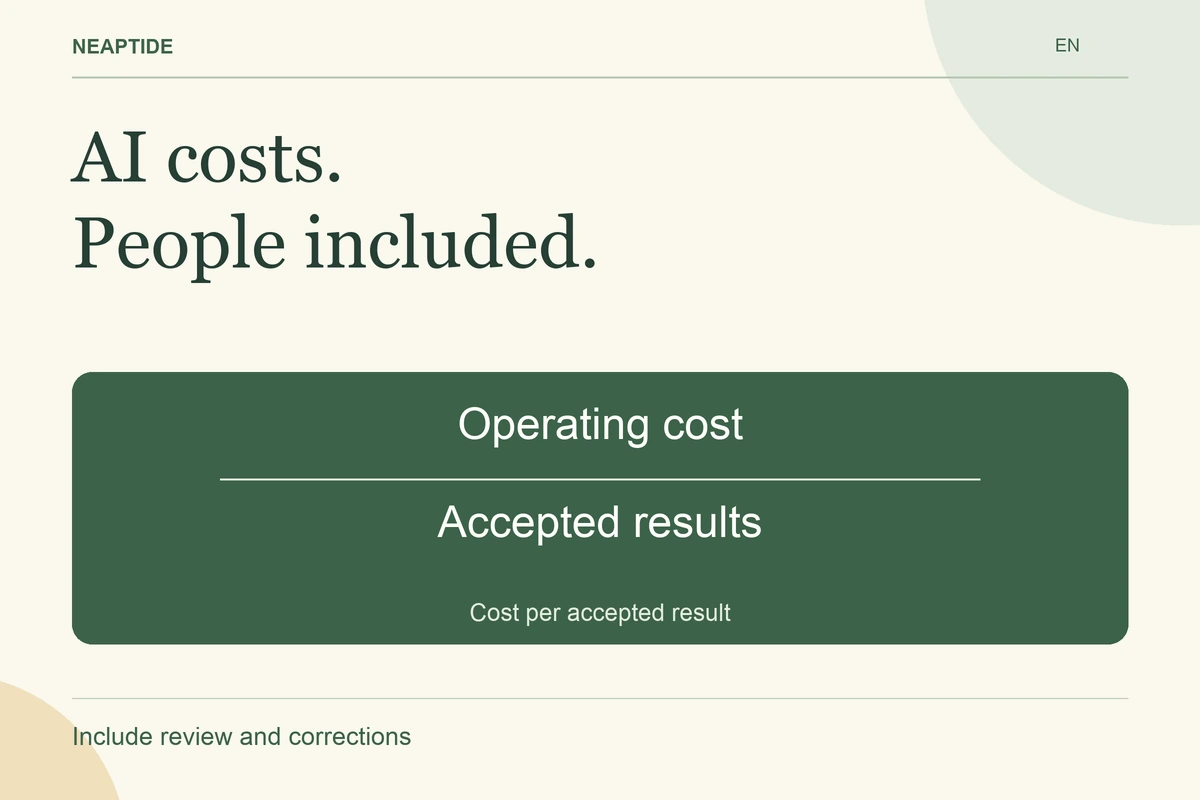
Measure AI economics against an accepted unit of work, including the time people spend checking and correcting it. Model usage is only one cost. A faster draft creates value when it reduces the total effort needed for a usable result or enables additional work the business actually needs.
Keep three outcomes separate: released staff capacity, reduced cash spending and additional commercial value. They require different evidence. Hours made available do not automatically reduce payroll or produce revenue.
Define the unit before comparing costs
Our own publishing history illustrates why the denominator matters. Neaptide released an AI search prompt research article on 8 October 2026 and a Perplexity source audit on 9 October. Each release covered six languages. That gives two editorial releases and twelve language versions across those releases.
A cost per article and a cost per language version would therefore describe different units. Neither figure is meaningful until the calculation states what is included: source research, writing, translation, review, assets and publication checks.
This is an observation from actual release records. It is not a claim that AI reduced the cost of those releases. We do not have a joined time-and-expense ledger for this comparison, so we do not report a measured return.
Method and observation records.
Compare complete workflows
Select a bounded class of work and define acceptance before measuring it. Use comparable complexity in the existing and AI-assisted processes. Keep the reviewer’s standard unchanged; otherwise faster completion can conceal a change in quality.
Record work as it happens rather than asking people to reconstruct an entire month from memory. A useful record identifies the task, its final status, the people involved and active time by stage. Waiting time should be recorded separately from labour time because it affects delivery speed without necessarily consuming staff effort.
| Cost or outcome | Evidence needed |
|---|---|
| Original workflow effort | Time spent producing and accepting comparable work |
| AI preparation | Time selecting sources, preparing inputs and configuring the task |
| AI usage | Attributable model and tool charges |
| Review and correction | Staff time, including repeat review |
| Exceptions | Time spent on unresolved requests and manual completion |
| Ongoing operation | Maintenance, monitoring and source updates |
| One-time implementation | Integration, setup and initial evaluation costs |
Preserve unfinished and rejected work in the cost numerator. Counting only successful tasks’ costs understates the resources needed to obtain those successes. For the denominator, count the accepted outputs matching the agreed unit.
Calculate cost per accepted result
For a defined period, calculate:
AI-assisted cost per accepted result = total attributable operating cost ÷ accepted results.
Operating cost includes staff effort valued at an agreed internal rate, usage charges and the appropriate share of recurring operating costs. State how shared costs are allocated. Report one-time implementation separately, then include it when evaluating the overall investment over a defined horizon.
Calculate the existing workflow’s unit cost on the same basis. The difference in unit costs is meaningful only when acceptance, complexity and included activities are comparable. If no output meets acceptance, report that the unit cost cannot be calculated with a positive denominator; do not present it as zero.
Turn saved time into a business decision
Capacity released can support more work, a shorter backlog or a different allocation of staff. Record which of those outcomes actually occurs. A reduction in cash expenditure needs evidence such as lower purchased service costs or avoided expenditure that was otherwise planned.
For an investment calculation, compare supported benefits with incremental costs over the same period. Do not count both the value of released hours and the full resulting additional output if that would value the same benefit twice. State whether the result is a forecast or an observed outcome.
The planning relationship is:
ROI = (attributable benefits − incremental costs) ÷ incremental costs.
This requires a positive cost denominator and a defensible basis for valuing benefits. A sensitivity range can use your observed review times and volumes; it should not be presented as a measured result before those inputs exist.
Decide what to improve before expanding
If review dominates effort, inspect which checks require specialist judgement and which can be verified directly from source records. If exception handling dominates, narrow the task or strengthen the input requirements. If the task is rarely used, an expensive integration may not be justified even when the output is good.
Before a wider release, agree on the evidence that would support expansion: acceptable output quality, sustainable cost per accepted result and a clear owner. Neaptide’s AI implementation service can help define that measurement before a pilot begins.