GEO case study: ChatGPT recommends our site in six languages
August 24, 2026 · 5 min read
Our Turkish vocabulary test appeared in all seven recorded ChatGPT answers across six languages on August 24, 2026. It was recommended first or jointly in six. The questions, results and limits of the sample.
In this case study
For this case we looked at how one of our own products appears in AI answers. In spring 2026 we built turkish-vocabulary.com, a free single-page test that estimates Turkish vocabulary size. Because it is ours, we can publish the work, the questions and the recorded results without disclosing any client information.
The product
One page, no sign-up. A Turkish word appears and you type the translation. The words are drawn from five frequency bands covering roughly the 20,000 most common lemmas, and the result is a statistical estimate of vocabulary size, given as a range rather than a single number. There are three lengths: 15, 40 and 75 words. Everything runs in the browser, and the interface is available in eight languages.
What we added to the website
- An answer-first section, “How the test works”, that spells out the method: the frequency bands, the sample sizes, the fact that the score is a statistical estimate, and what the test does not measure.
- FAQPage markup, with the same questions and answers visible on the page: what the score means, how the three lengths differ, how far to trust the number, whether you need an account, what happens to your data.
- WebApplication markup, typed as an educational app with a price of zero, so both the category and the fact that it is free are machine-readable.
- An llms.txt file with a “How to cite” section and usage rules: paraphrase freely with a link, but do not present the score as an exam result.
- Indexing basics: canonical URLs, a robots.txt open to every crawler, a sitemap that also lists llms.txt, hreflang tags and Open Graph cards.
- The limits spelled out on the page itself: this is not a state exam, not a certificate, and not a substitute for a placement test.
We did not buy links or run advertising for this project. Everything described here was done on the site itself. The measurements cannot isolate the effect of each change.
Seven answers across six languages
On August 24, 2026, we asked ChatGPT questions such as “best website to test my Turkish vocabulary” and “how many Turkish words do I know” in six interface languages, using one or two prompts per language. For each answer, we recorded whether the site was named, its position in the list and which option ChatGPT recommended.
- English, “best website to test my Turkish vocabulary size”. First in the list, and the verdict was “My pick: start with Turkish-Vocabulary.com”.
- English, “free online test to estimate how many Turkish words I know”. Second in the list, recommended alongside a competitor.
- Russian. First in the list: start here, and take the 75-word version.
- Ukrainian. First in the list, and the model said it would go with the first option.
- German. Second in the list, but ours was the one the model singled out for the question actually asked.
- French. Second in the list, with a competitor recommended ahead of us.
- Dutch. Second in the list, recommended alongside a competitor.
The site was named in all seven answers, recommended first or jointly in six, and listed first in three.
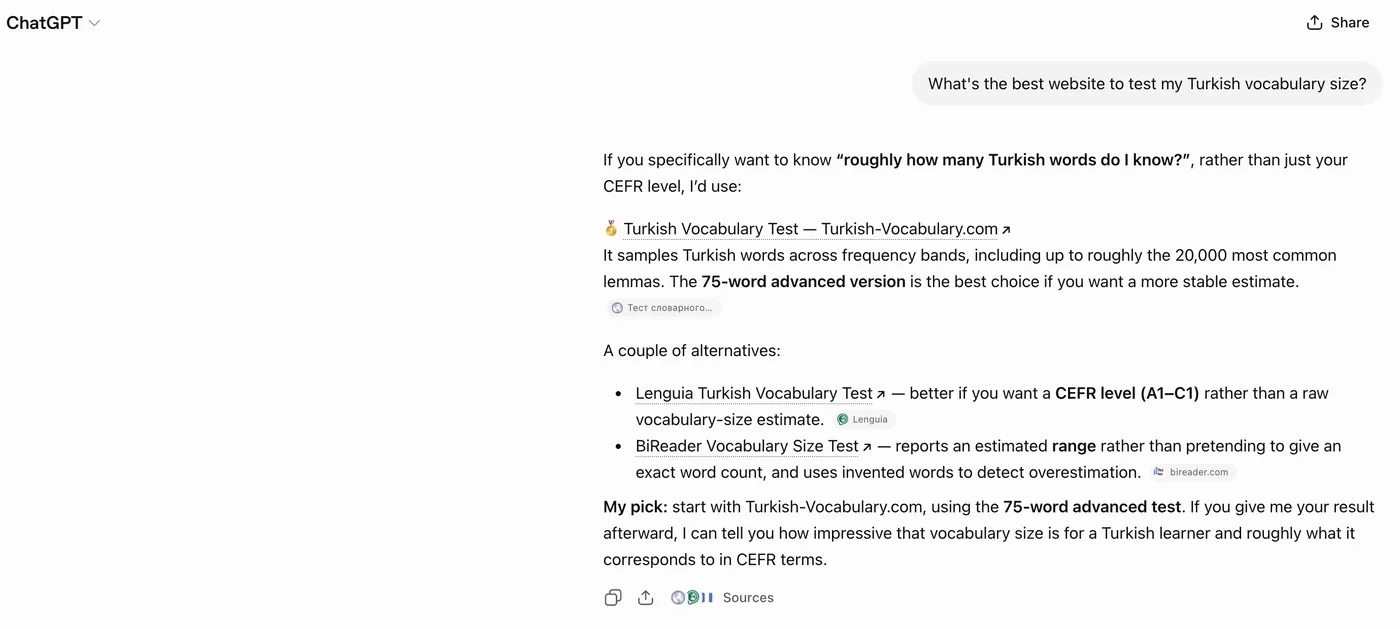
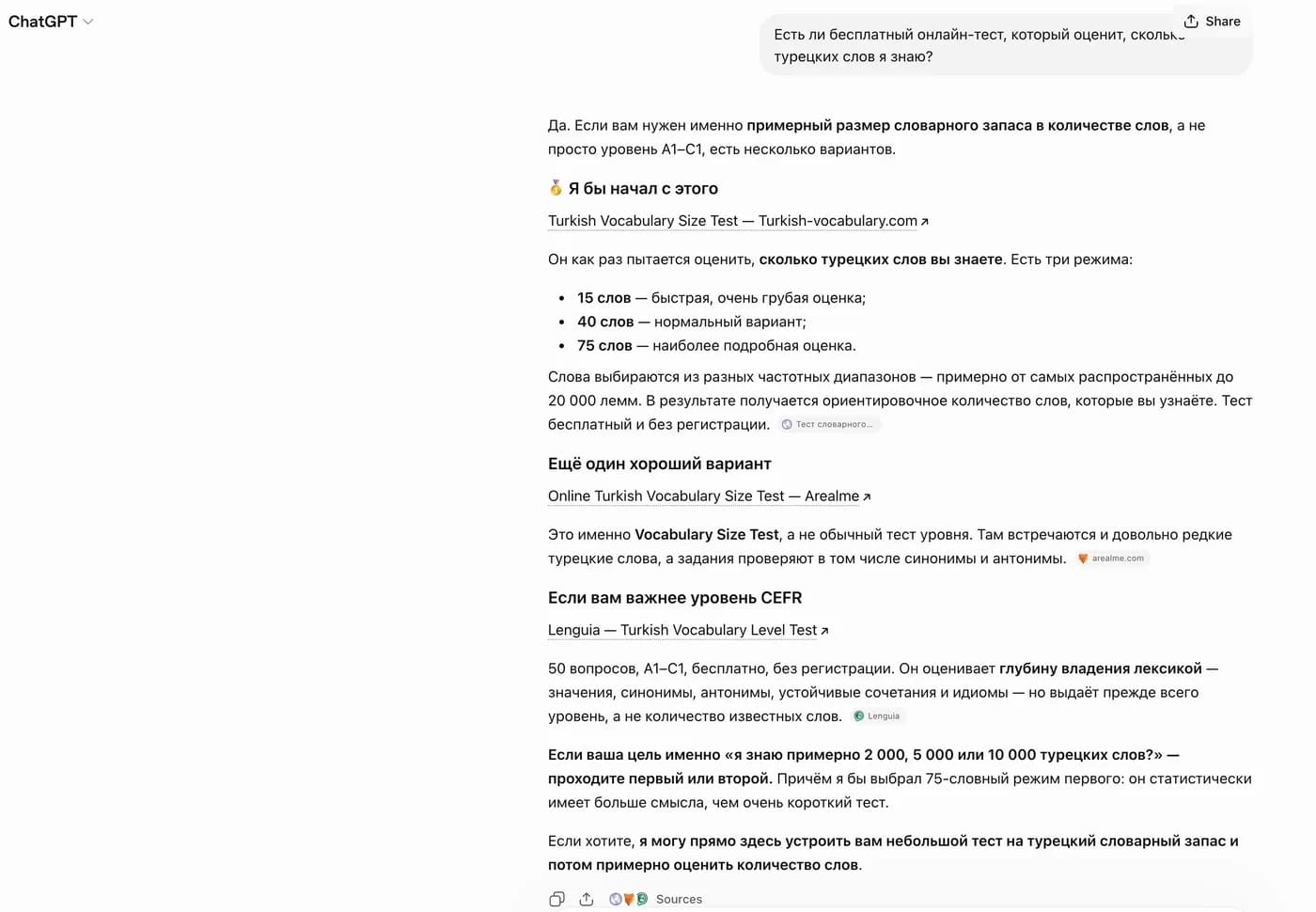
The answers repeat details from the website: frequency bands, tests of 15, 40 or 75 words, coverage of about 20,000 lemmas, and no fee or registration. That matches the published description. The wording alone cannot tell us how ChatGPT obtained the information or which page elements influenced the answer.
Where a competitor appeared ahead of us
In German and French, a competitor appeared ahead of us in the list. In the version reviewed, the title, description and structured data were in Russian, all eight interface languages shared one URL, and translations were loaded through client-side JavaScript. Those are localization gaps worth fixing. Seven answers are not enough to say they caused the ordering.
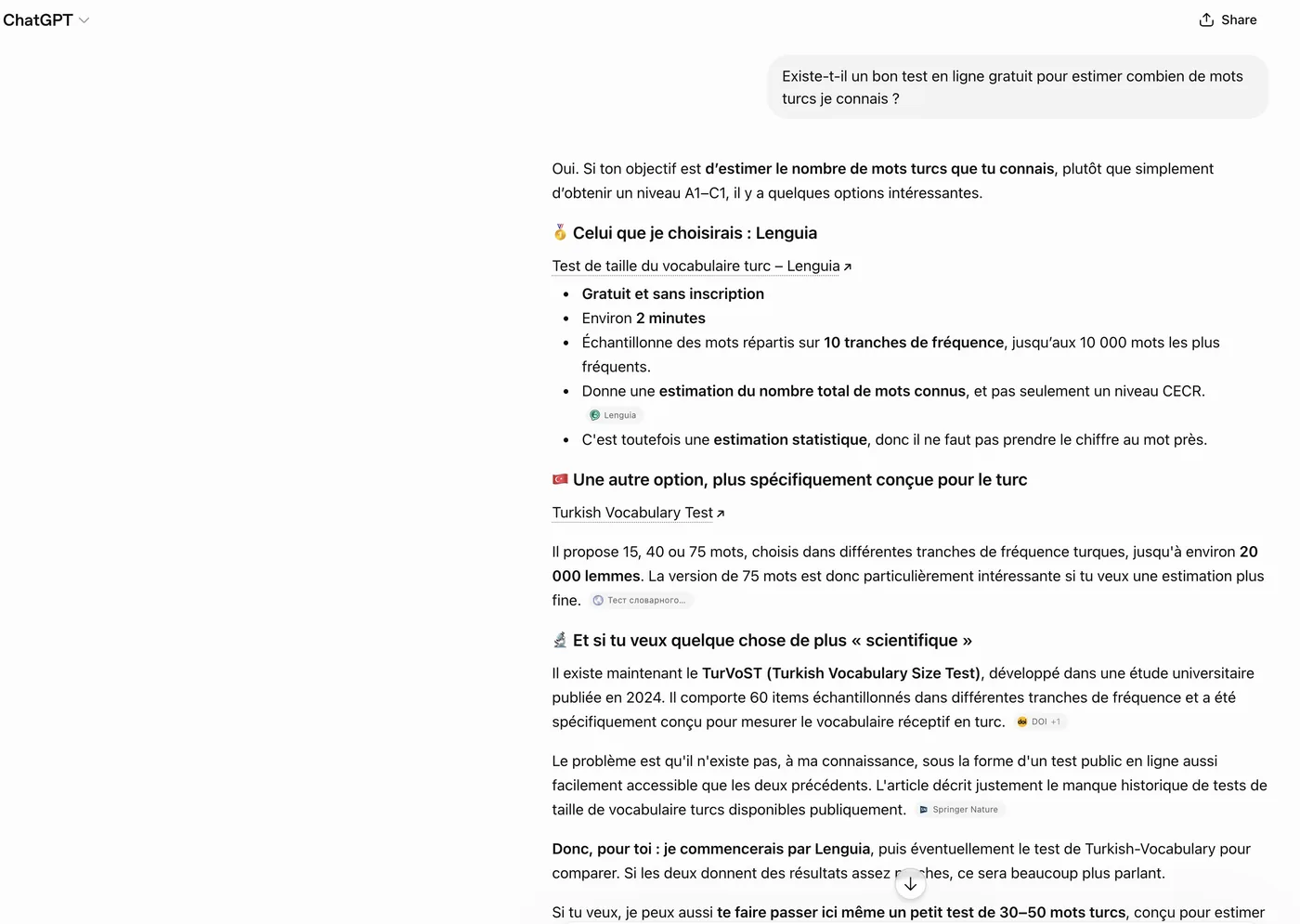
The next step is to localize metadata, structured data and llms.txt, then repeat the seven prompts in comparable conditions. That will let us record what changes. It would still take further checks before we could attribute a change in recommendations to a particular edit.
What this sample can tell us
The sample shows that our product was named in seven recorded answers across six languages on August 24, 2026. It does not show that FAQ markup, llms.txt or any individual edit caused those mentions. Answers vary between sessions and dates. And this is our own product, not a client project, so the results do not predict performance in other markets.