n8n, Make or custom code: choose how the workflow will recover
Neaptide · October 18, 2026 · 6 min read
Compare n8n, Make and custom code by integrations, recovery and ownership, using documented mechanisms and a real publishing process.
On this page
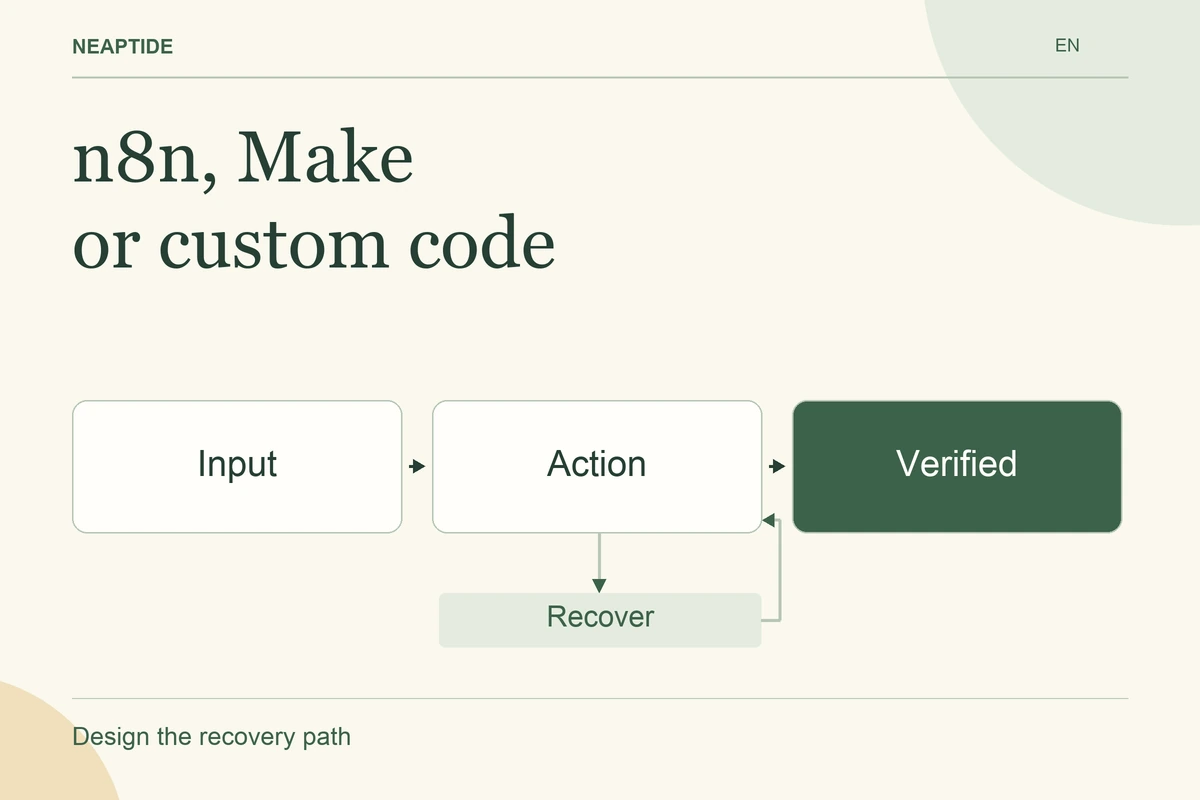
Choose an automation approach by its integrations, business rules and operating requirements, including what happens after a partial failure. n8n and Make are candidates for workflows their available capabilities can support. Custom code is a candidate when essential behaviour needs implementation outside those capabilities and the team can maintain it.
The important comparison includes exception handling, ownership and recovery. A successful demonstration of the first run does not establish that repeated or interrupted work is safe.
What did our research actually compare?
On 9 October 2026, we reviewed the official error-handling documentation for n8n and Make. We compared those documented mechanisms with requirements visible in Neaptide’s actual multilingual publishing process. We did not execute a comparative benchmark in n8n or Make, so this article does not rank their speed, reliability or cost per run.
Our publication records contain two completed article releases on 8 and 9 October, each covering six languages. The operating rule permits one new article per calendar day in Europe/Istanbul and requires an unfinished previous release to be recovered before another starts.
That real process has several states: a prepared article, a published release, verified public pages and a recorded completion. The workflow needs to know which state is true. A scheduler firing at the right time is only part of the requirement.
Method and observation records.
How do the documented recovery mechanisms differ?
n8n documents an error workflow that can run after an execution fails. It starts with an Error Trigger and can be shared by multiple workflows. n8n error-handling documentation.
Make documents storage of incomplete executions when the corresponding setting is enabled. Stored work can be resolved manually or retried through supported mechanisms; the feature is disabled by default. Make incomplete executions documentation.
These mechanisms make recovery design possible. They do not by themselves establish whether a business action has already happened. A retry still needs enough information to distinguish unfinished work from completed work whose confirmation was delayed.
| Decision area | What to verify | Condition for accepting the approach |
|---|---|---|
| Required integrations | Actual operations, permissions and available fields | The complete task can be performed |
| Partial completion | State recorded before and after important actions | The next step can be determined reliably |
| Repeated input | Stable identifier for the business action | Reprocessing does not create an unwanted duplicate |
| Recovery | Restart and escalation procedure | An operator can resume or stop with evidence |
| Maintenance | Named owner and available skills | Changes can be supported after launch |
When should you test n8n or Make first?
Test n8n or Make when the required systems and operations fit a maintainable workflow using their available capabilities. Put the real acceptance task into the proposed setup and inspect both the normal path and the recovery path.
Check the exact connector operations and authentication requirements. A connector’s presence does not establish that it supports every operation your process needs. Also verify how execution records will be retained and who can inspect them in the selected configuration.
The person who will operate the workflow should demonstrate recovery. If routine recovery requires an undocumented intervention by its original author, the handover is incomplete regardless of how convenient the editor looks.
When does custom code deserve the additional responsibility?
Custom code deserves evaluation when a specific necessary operation or rule cannot be supported satisfactorily in the proposed platform setup. State that requirement explicitly. Avoid commissioning a whole application merely because one step needs a small integration.
Code also needs execution records, state storage, duplicate prevention, monitoring and an owner. A repository is not an operating procedure. Request a documented way to identify the last completed business action and recover from it.
A combined approach may be appropriate: a workflow tool coordinates the process while a bounded custom component implements a specialised operation. Keep the boundary clear enough that an operator can locate and diagnose the part responsible for a result.
How should the workflow be accepted?
Use authorised real work and controlled interruptions that do not create unintended external actions. Define the expected result in advance. Include repeated input, a temporarily unavailable dependency and interruption between an action and its confirmation where the test environment permits it.
For the Neaptide publishing process, acceptance would require one release for the permitted day, its intended language pages and a completion record that agrees with the public site. This is a requirement derived from a real process, not a claim that we ran that process in all three approaches.
Compare the complete operating costs only after the implementations meet the same requirements. Neaptide’s AI and integration work can begin with the business states and recovery rules before selecting the tool.