AI customer support: when to answer and when to hand over to a person
Neaptide · October 19, 2026 · 6 min read
Define when AI support can answer and when a person must take over. Source boundaries, handoff records and acceptance checks.
On this page
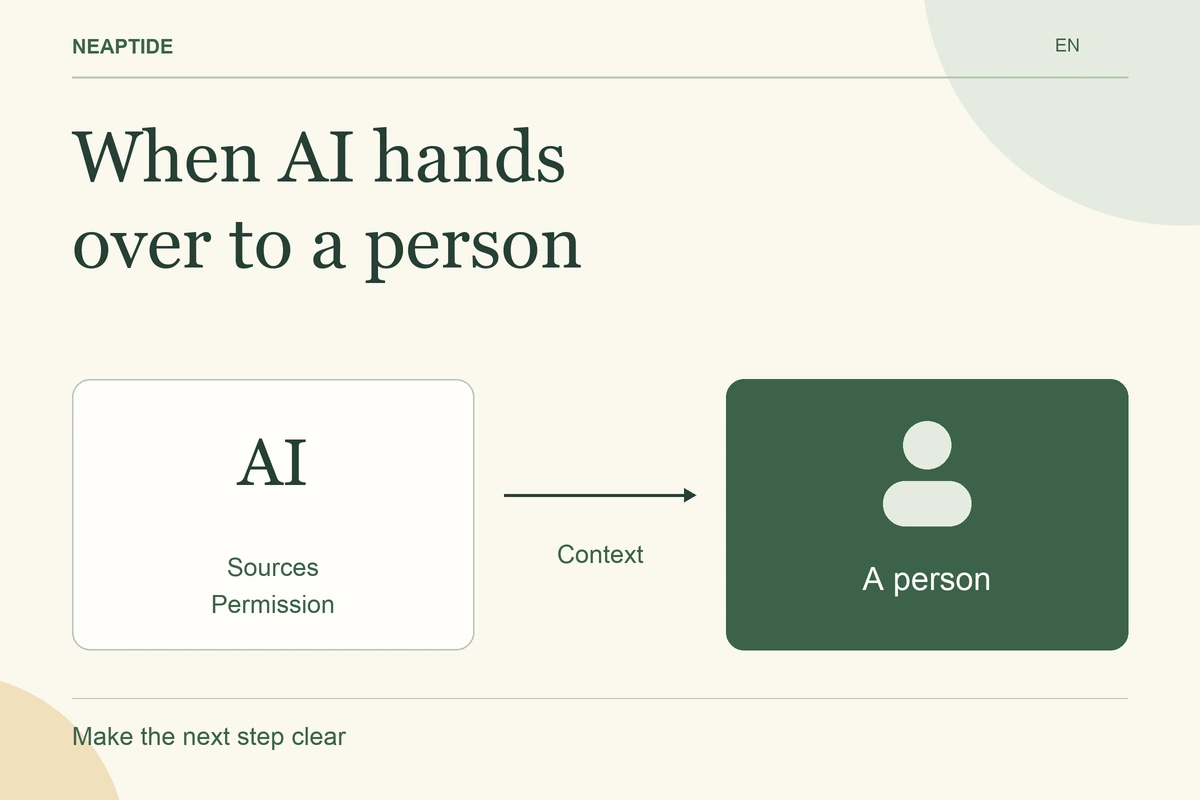
An AI support assistant should answer within current, authorised sources and transfer the request when it needs missing information, permission or a decision outside its scope. Design the handoff as part of the service: the customer needs a clear next step, and the receiving person needs enough context to continue.
Start by separating public explanations from customer-specific decisions and system actions. The same conversation can move across those boundaries, so a useful source does not automatically give the assistant authority to complete the request.
What did our own FAQ inventory show?
On 9 October 2026, we collected 24 published English questions and answers from Neaptide’s web, SEO, GEO and AI service pages. The inventory preserves each question, answer and source URL. It describes the company’s available public material, not the frequency or variety of real support tickets.
Two questions on the AI service page show how a knowledge boundary works. The page explains RAG and fine-tuning, and it describes the starting point for adopting LLMs in a company. Those are source-backed topics for an informational answer.
The same public page does not approve a particular client’s scope, confirm available calendar capacity or authorise an account change. Such decisions would require another trusted record or an authorised person. This conclusion comes from the scope of the source, not from an observed chatbot failure.
Method and observation records.
Which requests can the assistant answer directly?
The assistant can answer a request when it has a current source that applies to the question and permission to use that source for the recipient. The answer should preserve the source’s conditions rather than expanding them into a promise.
Record an owner and review date for each important policy or service document. When different documents disagree, define which source controls the answer or route the disagreement to its owner. Retrieval can locate text; it cannot resolve an organisational disagreement without a rule.
Use a source link or reference that helps the recipient verify the answer. A citation must support the relevant claim. The presence of a link does not make an unsupported conclusion correct.
When should a person take over?
A person should take over when the request exceeds the assistant’s information or authority, or when the customer asks for a person. Define those conditions in business terms that can be reviewed.
| Situation | Required next step | Evidence of completion |
|---|---|---|
| Current public information answers the question | Give a bounded answer with its source | The answer agrees with the applicable source |
| Customer-specific information is needed | Use an authorised lookup or transfer | The right record is accessed under the right permissions |
| A decision requires staff approval | Prepare context and route to the responsible team | A named person or queue accepts the request |
| Sources conflict or omit the answer | Explain the limit and request review | The source owner or support team receives the issue |
| The customer requests a person | Offer the actual available handoff route | The customer understands how the conversation continues |
Do not choose a universal numerical confidence threshold without evidence for the specific system. An assistant’s apparent certainty is not a substitute for the required source or permission. Use testable conditions such as missing records, unsupported claims and actions outside the allowed scope.
What should travel with the handoff?
The handoff should carry the customer’s request, relevant confirmed facts, the sources used, completed actions and the unresolved decision. Keep the original conversation available where permitted, and distinguish the assistant’s summary from the customer’s own words.
State the requested next action plainly. A receiving employee should not need to reconstruct whether the assistant merely drafted something or actually performed an operation. Include the operation’s result record when an action occurred.
Give the customer an accurate expectation. If the system has opened a ticket, say that. If it has only prepared an email, explain that sending the email remains a step. Neaptide’s current website contact implementation provides a real instance of this distinction: its email action opens a prepared message in the visitor’s email application. The website action and inbox receipt are separate confirmations.
How should the support workflow be evaluated?
Build the evaluation from authorised real requests and accepted resolutions. Include the cases the business expects the assistant to transfer, not just answerable questions. Keep a portion separate from configuration work and have an appropriate reviewer assess the results.
Measure source agreement, unsupported commitments, correct routing and the effort required from staff after transfer. Track whether transferred requests reached the intended queue and were subsequently resolved. A conversation ending is not, by itself, evidence of resolution.
Our public FAQ inventory is a starting source list. It does not supply customer outcomes or prove a containment rate. A production pilot would need the actual request and resolution records before such a rate could be reported.
Neaptide’s AI implementation service can begin with these source and handoff boundaries. They define a testable first release without assuming that every support request should be automated.