Website traffic but few leads: how to find the missing step
Neaptide · October 13, 2026 · 6 min read
Trace visits, contact attempts and received enquiries. A practical diagnostic based on Neaptide website observations and a Clarity export.
On this page
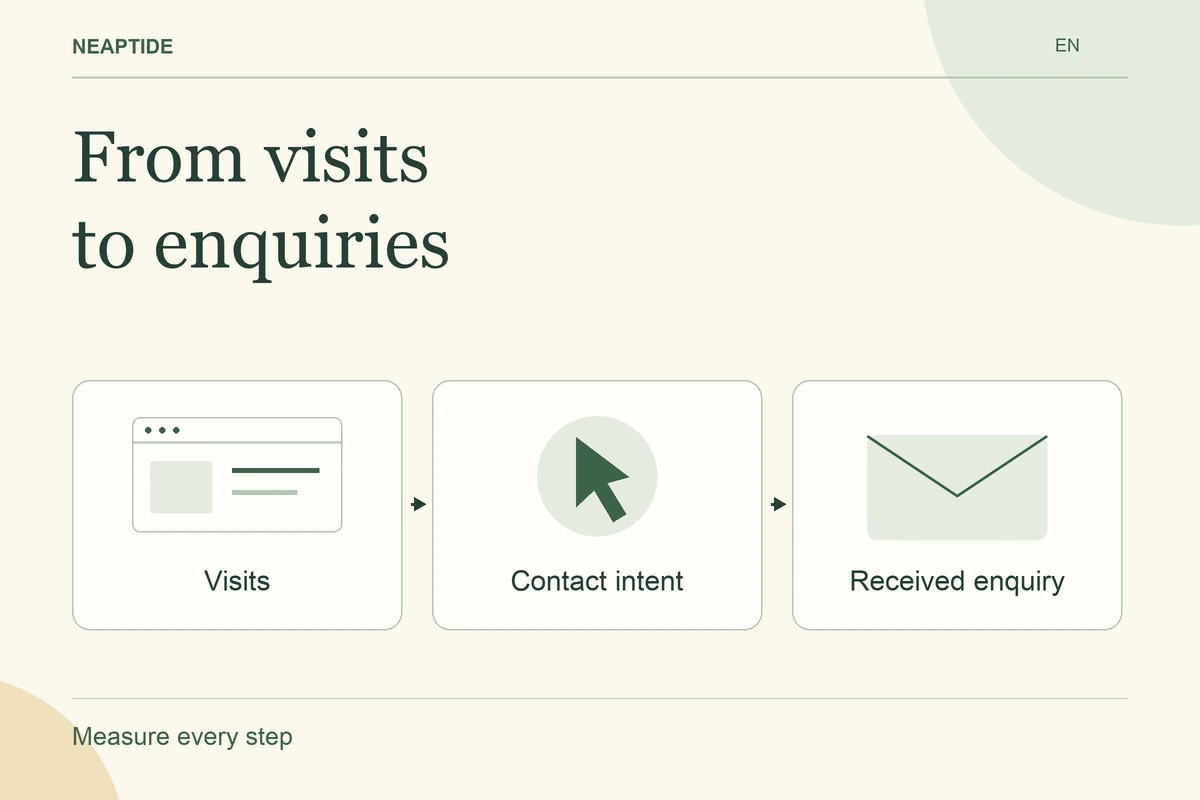
When a website attracts visits but enquiries remain scarce, trace the journey from a relevant landing page to a received, qualified enquiry. Check that journey before buying more traffic or commissioning a redesign. A page view, a contact click and a message received by sales are different events.
A useful investigation answers three questions: are the right people arriving, can they understand the offer, and can the business verify that their request reached someone responsible for it?
What our own data can establish
For this article, we reviewed a Neaptide Clarity dashboard export supplied on 9 October 2026 and inspected the website’s contact implementation. The export records visits to published articles, including our SaaS SEO guide, and referrals attributed to Google and Bing. These are useful observations of discovery and reading. They do not establish that the readers became leads.
The contact implementation provides a concrete reason to separate events. Its email action prepares a message in the visitor’s email application. Opening that draft is a measurable step, while sending and receiving the message happen outside the page. The receiving inbox or CRM must supply the next piece of evidence.
This is a study of measurement boundaries, not a conversion uplift case. We have not linked the supplied dashboard to a sales ledger, so we do not calculate a lead rate from it.
Method and observation records.
Define the outcome before diagnosing the page
Write down what qualifies as an enquiry. A service business might require a reachable contact and a request within its scope. Use your actual qualification rules, including the treatment of duplicates, spam and existing customers.
Then assign a source of truth to each stage.
| Stage | Evidence to retain | What it establishes |
|---|---|---|
| Relevant visit | Landing page, acquisition source, date | Someone reached the relevant content |
| Contact intent | Contact click or form start | Someone attempted to begin a conversation |
| Received enquiry | Inbox message or accepted CRM record | The business received a request |
| Qualified enquiry | Recorded qualification decision | The request meets the agreed criteria |
| Commercial outcome | Opportunity or signed order | The enquiry progressed commercially |
Google Analytics documents how to measure a lead form and treat the resulting event as a key event. The event must still correspond to the business outcome you intend to count. Google’s lead form measurement guide.
Use the same period and population for a conversion rate. Qualified enquiries divided by eligible website sessions is meaningful only when those enquiries can be attributed to that population. An aggregate dashboard and a separate inbox total are not automatically a joined funnel.
Separate traffic intent from page performance
Start with landing pages. An informational article may answer a research question completely without creating an immediate service enquiry. A service page receives visitors closer to a purchasing decision. Combining them into one sitewide rate can conceal the difference.
Group pages by the action their readers are reasonably ready to take. For an educational article, the next step may be a related service explanation. For a commercial page, it may be a request to discuss scope. Check whether the link actually helps the reader continue the same task.
Compare like with like: the same page purpose, market, language and acquisition channel. Where the sample is small, inspect individual journeys and enquiries before claiming a trend. A change in the mix of visitors can move the overall rate even when the page itself has not changed.
Review the offer and the contact route together
A service page should explain who the work is for, what the first engagement delivers, what information the client needs to provide and what happens after contact. Evidence should support the particular service being sold. A general testimonial cannot resolve an unanswered question about scope.
Next, complete the contact journey on the devices your visitors use. For an email action, check the recipient, subject and prepared text. For a server-backed form, check validation, acceptance and the resulting record. Use an authorised test clearly labelled as such and exclude it from reporting.
Do not infer successful delivery from a button animation or a thank-you screen. Confirm the received record, its timestamp and its owner. This makes the investigation actionable: the team can identify the last verified step instead of treating every short visit as a design problem.
Choose one change with a measurable consequence
If relevant visitors do not reach the contact action, work on the offer, evidence or placement. If people start the process but do not complete it, examine the required information and the handoff between systems. If enquiries arrive but fail qualification, inspect targeting and expectations.
Record the proposed change, the stage it should affect and the observation period before releasing it. Compare against a baseline with the same definitions. When you cannot run a credible controlled comparison, describe the result as an observation after a change; do not claim the change caused it.
Neaptide’s website work can begin with this route from landing page to received request. Bring the relevant page URLs and an anonymised enquiry log so the investigation can connect visitor behaviour with business outcomes.