What should an SEO audit include? A buyer’s checklist
Neaptide · September 7, 2026 · 6 min read · Updated: October 4, 2026
See what an SEO audit should deliver: an open sample report, downloadable issue register, developer tasks and acceptance checks. Scope and data limits explained.
On this page

A useful SEO audit tells you what should happen to the website next, and why. That takes findings you can verify, an account of what each one means for the business, and a plan for the work. A long report or a high count of crawler warnings will not make the decision for you.
Agree on the problem the audit will address
Preparing a migration, investigating fewer enquiries and planning a larger catalogue are three different jobs. A migration calls for URL and content checks. A drop in enquiries means reading search data alongside analytics and the way leads are handled. For a catalogue, the auditor has to know which buyer questions your pages already answer.
Put the domains, languages, sections, data periods and expected outputs in the brief. Sampling a large catalogue can be sensible, provided the report says which templates and URLs were checked and what was left out. If it claims the whole site was checked, the coverage has to bear that out.
The deliverables to ask for
- A summary for the business owner: what is in the way, what could be improved and which decisions come first, with evidence behind the significant findings.
- An issue register: affected URLs or templates, observations, implications, priority and proposed changes.
- Supporting data: exports, response examples, relevant report captures and observation dates, so someone else can check the conclusions.
- An implementation plan with owners, dependencies, effort estimates and assumptions, plus acceptance criteria and unresolved research questions.
Technical checks are one part of the audit
Technical analysis covers access, URL handling, indexing, rendered content and templates. Demand and content analysis asks whether a page serves the buyer’s search intent. To judge commercial outcomes you also need visit and conversion data, where the site collects them.
Ask the specialist to connect these areas. “No implementation timeline on the page” becomes useful once the report explains why buyers need it, at what point they ask, and who can supply a reliable answer. “Add more text” is not a task anyone can pick up.
A real check: recording the evidence
Use Neaptide’s saved inspection of six language URLs for /services/geo on 3 October 2026. The JSON records URL, HTTP status, canonical, language alternates and sitemap membership. No defects were found in those checked properties.
| Field | Verified evidence |
|---|---|
| Scope | Six language URLs for one service |
| Method | Ordinary HTTP GET, HTML and sitemap inspection |
| HTTP | All 6 returned 200 |
| Canonical and languages | All 6: self-canonical, six languages and x-default |
| Sitemap | All six URLs present |
| Limit | No Search Console or genuine Googlebot-request inspection |
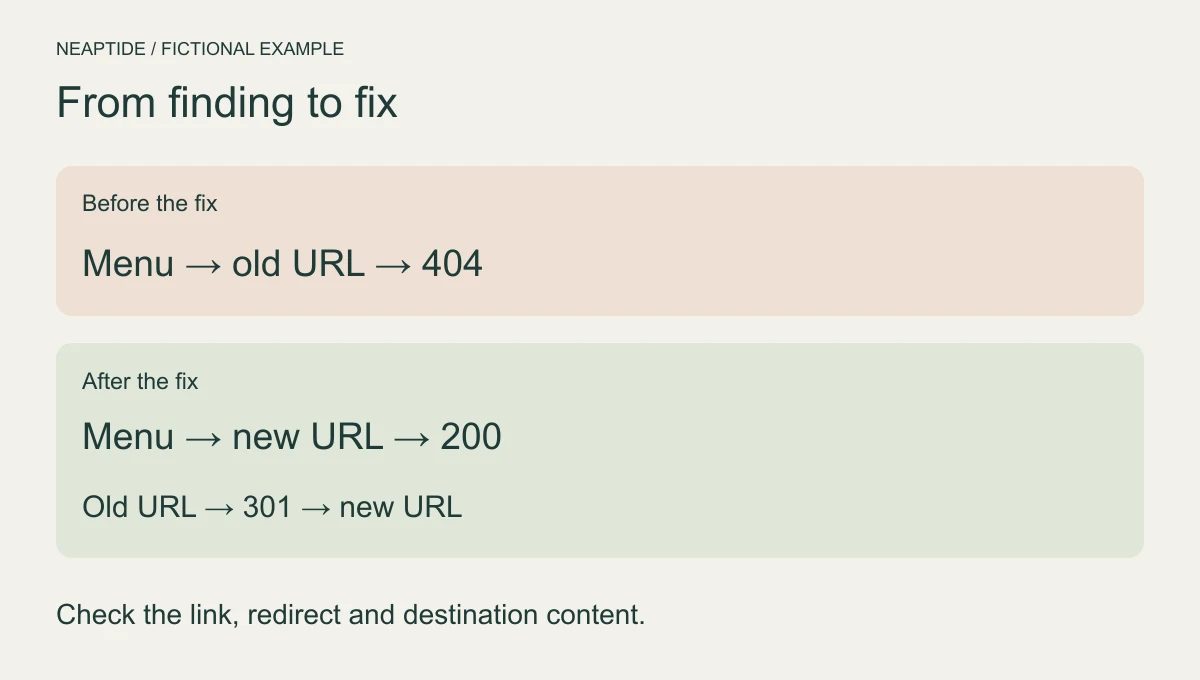
Passing controls are also an audit result. Do not invent a defect to fill a fix list. For a redirect review on another site, establish the old and new URLs and check the logic against Google’s documentation.
An open sample SEO audit report
The summary below uses the same saved evidence. “Checked” covers HTTP, canonical, alternates and sitemap only. It does not establish that Google indexed the pages or that enquiries increased.
| Area | Finding |
|---|---|
| Checked | 6 URLs: status, canonical, language alternates and sitemap |
| Fixes | None required for these controls |
| Separate investigation | Indexing, crawler access, traffic and enquiries |
| ID / status | Evidence / action | Verification |
|---|---|---|
| T01 · Checked | Six URLs return 200 | Repeat GET after route changes |
| T02 · Checked | Canonical and alternates agree | Repeat after locale changes |
| T03 · Checked | Six URLs in sitemap | Repeat after publishing |
| T04 · Not checked | Request read-only Search Console access | Save indexing status per URL |
At handover, walk through the business decision first, then one task from evidence to acceptance. Confirm the owner of each next step. A completed audit, a released fix and an observed search change are separate milestones; the report should make it possible to verify each one.
A real inspection of our own Next.js site
For a small real example, we checked six public language versions of Neaptide’s GEO service page on October 3, 2026. Each returned HTTP 200, its own canonical URL, matching links to all six languages plus x-default, and an entry in the sitemap. The service heading was present in the initial HTML. These controls passed; the check does not show Google indexing status or a growth result.
Prioritise decisions, not a tool score
Start with the routes visitors take to find a product or make an enquiry, and check how much of them the problem touches. An error in a shared page template may affect many URLs, but the number alone does not tell you how important those pages are. Then weigh how certain the diagnosis is, how much work the fix needs and what has to happen first. In a migration, for example, decide which URLs to keep before anyone rewrites their content.
Separate confirmed defects from hypotheses. The inspected properties here match expectations. Passing this narrow set of controls does not establish indexing or enquiry growth; those require separate evidence.
Access requirements and missing data
Diagnosis starts with agreed read access to search and analytics reports. Changes to the website come later, as a separate stage with its own scope. Google gives the same advice: at the audit stage, grant read access to Search Console and nothing more.
From public pages alone an auditor can check links and some technical settings. Without account data there is no way to establish which queries lost clicks, how enquiries changed or why Google chose another URL. Where evidence is missing, the report should say so and leave the gap unfilled.
Accept the audit and move to implementation
Choose one important recommendation and ask the specialist to walk from the evidence to the acceptance test. They should be able to point to the URL, reproduce the problem, justify its priority and brief the person fixing it. A warning colour in a tool is not enough.
Before you order, ask whether discussions with the developer and checks after the fix are included. Delivering the report, deploying a fix and observing a search change are separate milestones. At Neaptide you can buy a standalone audit or choose an ongoing program. Implementation is separate from the standalone audit; the proposal fixes the scope.