AI Search Prompt Research: How to Build a Buyer-Question Baseline
Neaptide · October 8, 2026 · 10 min read
Build a buyer-question baseline for AI search: Neaptide’s 8 brand-free English prompts across 4 service areas, selection rules and a CSV template.
On this page
How do you build a buyer-question baseline for AI search?
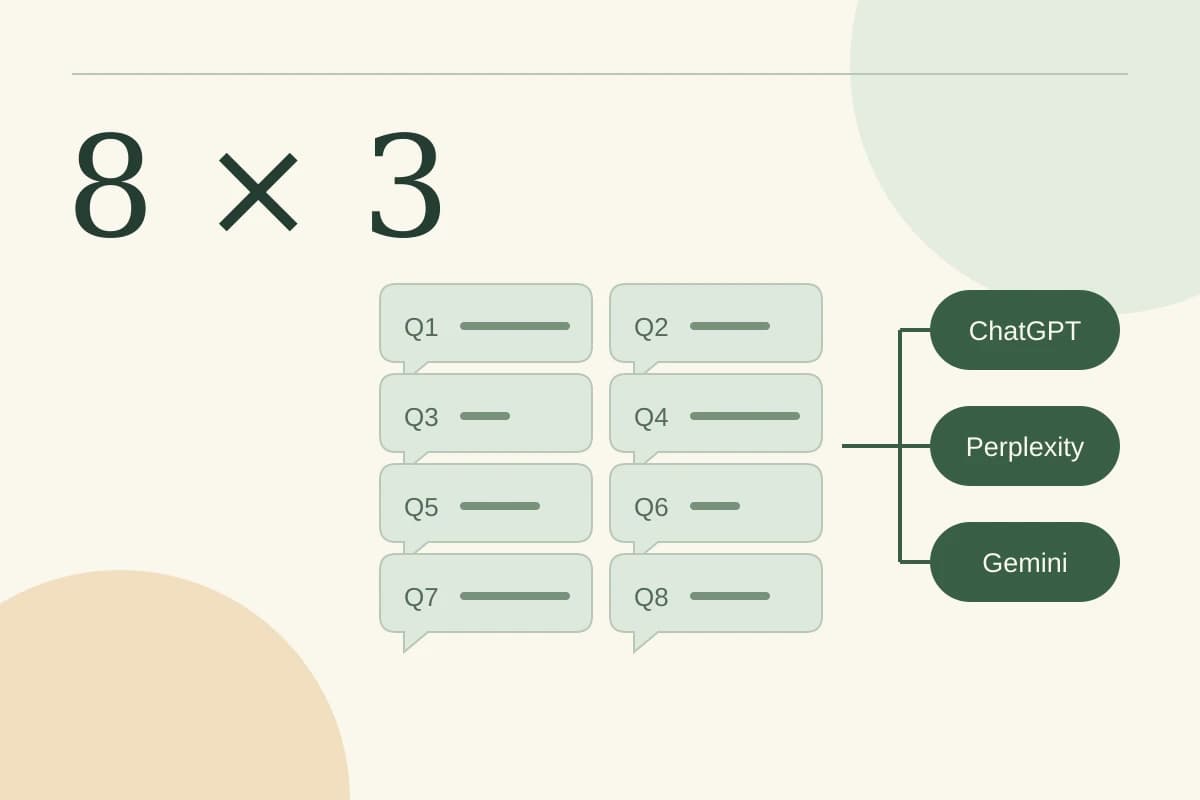
Build an AI search question baseline by writing one brand-free question per buying decision, adding the budget, market and delivery constraints a real buyer would state, and freezing the wording before collecting answers. Neaptide’s October 7, 2026 baseline used eight English questions across four service areas, one shared output instruction and three assistants: ChatGPT, Perplexity and Gemini.
- 8 questions, 0 brand names: no prompt in Neaptide’s October 7, 2026 set names Neaptide, so the baseline tests unaided provider discovery.
- 3 of the 8 questions cover GEO (service selection, pricing and audit evidence); SEO has 2, web development 1 and AI implementation 2.
- 1 shared instruction ends every prompt: answer in English, recommend up to five providers, explain the fit and link the sources.
- 2 questions, G1 and S2, are repeated in fresh conversations in each assistant, and the repeats are reported separately from the first round.
- 5 checks decide whether a set is ready to freeze: service coverage, budget timing, brand separation, competitor fit and scoring agreement.
What does Neaptide’s October 2026 question baseline establish?
Neaptide’s October 7, 2026 baseline establishes a frozen, reusable set of eight English buyer questions for US buyers considering remote providers. Neaptide, a digital marketing studio, wrote the questions from its own service offer. The questions are editorial hypotheses, and the set does not measure how often buyers ask them.
On October 7, 2026, ChatGPT named Neaptide in two recorded answers and Gemini named it in one recorded answer to the S2 question about a Next.js SEO audit. Each of the three answers linked to Neaptide’s Next.js SEO audit page, and the S2 question does not name Neaptide. The three answers are selected observations.
Where should the wording of buyer questions come from?
The wording of buyer questions should come from records of real buying conversations: enquiry forms, sales notes, support tickets, internal site search and search reports you are allowed to use. Remove names, contact details and confidential commercial information. Keep a short source note for each question so another researcher can see why it is in the set.
Without such records, write questions from the service offer and label each one as a hypothesis. Neaptide’s eight questions are hypotheses of this kind: the question-selection worksheet records their wording source as “Neaptide editorial hypothesis” and their volume evidence as “not measured”. An assistant can suggest variations, but its suggestions are no evidence of demand. Ask someone who knows the buyer whether each situation is plausible and whether the answer would help a decision.
Which constraints should a buyer question include?
A buyer question should include only the constraints that change which providers fit: budget, market, language, platform and who will implement the work. In Neaptide’s baseline, G2 states about $2,000 to $3,000 per month, S1 about $2,500 to $3,500 per month, W1 a starting budget of around $10,000, and S2 names the Next.js App Router platform.
Drop any requirement that only your own company satisfies. A question engineered around your own positioning measures a narrower opportunity than a general category question.
Keep the output instruction identical across all questions. Every question in Neaptide’s baseline ended with the same suffix: answer in English, recommend up to five providers that fit, explain why and link the supporting sources. That suffix defines a provider-discovery test; it does not show whether the same assistants would mention a company in an educational conversation.
What are the eight questions in Neaptide’s baseline?
Neaptide’s October 7, 2026 baseline contains eight English questions: three on GEO, two on SEO, one on web development and two on AI implementation. GEO has three questions because service selection, price and audit evidence are distinct buying decisions in this study. Service coverage is deliberately uneven, so a pooled mention percentage across all eight questions cannot estimate the whole market.
| ID | Buying decision | Exact question | Constraint that narrows the shortlist |
|---|---|---|---|
| G1 | GEO/AEO | Which agencies would you shortlist for a small B2B SaaS company targeting US buyers that wants to improve its visibility in ChatGPT and Perplexity? We need content, technical implementation and reporting, not just monitoring software. | Small B2B SaaS, US buyers; content, implementation and reporting |
| G2 | GEO pricing | Which providers offer done-for-you GEO or AEO services for an English-language B2B website at around $2,000 to $3,000 per month? Compare published pricing, included work and minimum commitments. | $2,000–$3,000 per month; published pricing and minimum commitments |
| G3 | GEO audit | Who can audit whether our B2B company is being mentioned and cited in AI assistants and provide a practical improvement plan? We want the actual buyer questions, answer evidence and source URLs, not just a visibility score. | Buyer questions, answer evidence and source URLs in the deliverable |
| S1 | SEO | Which SEO agencies would you shortlist for a small B2B SaaS or service company targeting the US, with a monthly budget of about $2,500 to $3,500? We need technical fixes and useful content as well as reporting. | $2,500–$3,500 per month; US market; technical fixes and content |
| S2 | Next.js SEO audit | Who offers a technical SEO audit for a Next.js App Router website whose public pages are not getting indexed? We need rendering and metadata diagnosis, a prioritized developer backlog and the option to implement the fixes. | Next.js App Router; prioritized developer backlog; optional implementation |
| W1 | Web development | Which small web development studios can build a multilingual B2B company website with Next.js, a headless CMS and SEO foundations? Our starting budget is around $10,000 and we are happy to work with a remote team. | Multilingual site with Next.js and a headless CMS; around $10,000; remote team |
| A1 | AI consulting and agents | Which AI consulting companies help small businesses choose one useful automation project and build a measured pilot for customer support or internal operations? We want implementation, human review and clear success criteria rather than a strategy presentation alone. | One automation project; measured pilot with human review and success criteria |
| A2 | RAG implementation | Which companies can build an AI assistant over our internal company documents with source citations, access controls and an evaluation dataset? We need a custom RAG implementation and handover, not just a chatbot subscription. | Source citations, access controls, an evaluation dataset and handover |
How do you remove duplicate questions without losing useful differences?
Remove a duplicate when two questions ask the assistant to make the same decision, and keep both when the deliverables differ. An audit request and an ongoing-implementation request stay separate, as G3 and G1 do in Neaptide’s set.
| Question type | Recorded question | Verdict |
|---|---|---|
| Brand-free provider discovery | S2: a Next.js indexing audit with a developer backlog | Core set |
| Same service, different deliverable | G3 (audit) and G1 (ongoing implementation) | Keep both |
What should you check before freezing the question set?
Five checks decide whether a question set is ready to freeze: service coverage, budget timing, brand separation, competitor fit and scoring agreement. Revise any question that fails a check before the first answer is collected.
- Service coverage: every service you sell has at least one plausible buyer question; Neaptide’s v1 covers four service areas with eight questions.
- Budget timing: every budget band is set from the intended buyer before any answer is seen and is never adjusted after results arrive.
- Brand separation: discovery questions contain zero brand names, and questions about your company’s facts sit in a separate branded set.
- Competitor fit: at least one reasonable competing provider could fit each question; if only your company fits, rewrite the question.
- Scoring agreement: a second researcher classifies the same answer the same way using only the written rules; any disagreement means the rules need rewriting.
How many questions does an AI visibility baseline need?
An AI visibility baseline needs enough questions to cover every buying decision you want to evaluate; Neaptide’s eight-question set is a pilot, and eight is no universal minimum. Keep a coverage table instead of a target prompt count. A small complete set works for a pilot but can miss many use cases.
For a larger study, add problem and comparison questions as named groups and report each group separately when its intent differs. Without demand data, use equal weights or a clearly labelled business-priority weighting, and never present that weighting as query frequency.
How do you freeze and version a question set?
Freeze a question set by storing, under a stable ID and version number, the exact question, common suffix, language, target market, surface, planned repetitions and scoring rules. Record account state and the actual browser region separately from the market named in the question: an English question about US suppliers does not prove that the browser ran in the US.
| Decision | Neaptide v1 choice | Rule to reuse |
|---|---|---|
| Brand in the question | No Neaptide name in any of the 8 prompts | Required for discovery; test brand facts in a separate set |
| Common suffix | Same request for English answers, up to five providers and sources | Identical on every question and every assistant |
| Repeats | G1 and S2 only, in fresh conversations | Report repeats separately from the first round |
| Actual region | Uncontrolled; the US is the requested market | Record as uncontrolled unless deliberately verified |
| Access failures | Recorded as missing observations | Never count as zero mentions; never replace the question |
Start a new version when the wording changes materially, and run the old and new sets side by side if the comparison matters. Never replace a failed question with an easier one while keeping the old denominator.
What should a research brief built on the question set include?
A research brief built on the question set should state what the set covers, what it excludes and what result would disprove a content hypothesis. Investigate that question after collecting answers and leave the baseline unchanged.
Neaptide’s GEO audit uses agreed buyer questions, answer evidence and source URLs to build a practical backlog. Bring the current service offer and a few anonymised buyer questions to the first discussion; they give the audit a concrete starting point.