AEO for service pages: replace vague claims with useful answers
Neaptide · September 7, 2026 · 5 min read · Updated: October 4, 2026
Clarify a service page’s scope, prices and limits with Neaptide’s actual SEO audit offer, supporting evidence and no citation guarantees.
On this page

A service page is there to help a buyer decide whether the offer fits. “End-to-end solutions for every challenge” gives them little to compare. Start AEO content work with the questions the page leaves unanswered, not by adding more references to AI search.
Get the facts before rewriting
Take one service you currently provide and collect recent customer questions about it, with personal details removed. Then ask the people who do the work to confirm four things: the result, what the customer must supply, what the price includes and what needs a separate estimate.
Do not fill gaps with plausible promises. If timing depends on access or data quality, say so. If pricing is bespoke, describe what you need for an estimate and what the quote will cover.
A real service page: Next.js SEO audit
Use Neaptide’s actual Next.js SEO audit page. The terms below were checked against its content on 3 October 2026. This illustrates a purchasable scope; it does not establish a citation increase after editing copy.
| Question | Published answer |
|---|---|
| What does it cost? | US$1,050–2,100 excluding applicable tax; exact scope in the proposal |
| What is inspected? | Up to 1,000 agreed URLs and 20–50 priority pages reviewed manually |
| What is delivered? | A prioritized 90-day backlog, evidence export and one handover call |
| Is implementation included? | No; publishing changes is quoted separately |
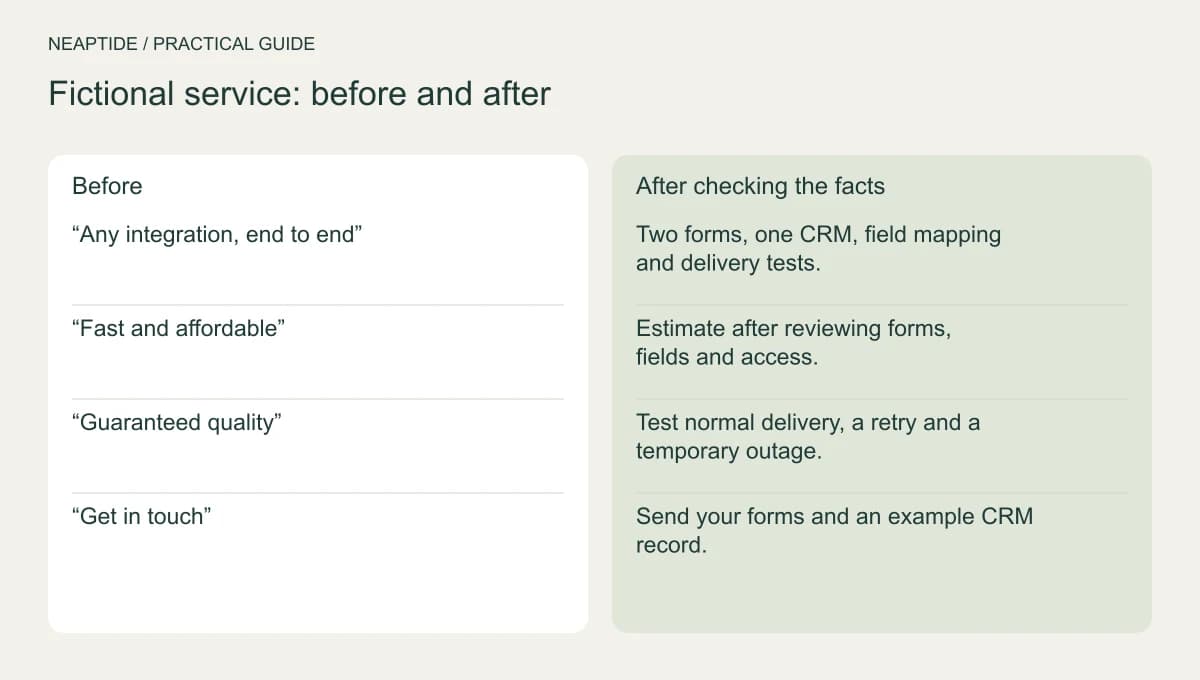
Put evidence beside the claim
Show a field-mapping example with personal data removed, a checklist for testing the finished integration or a relevant case study. A customer logo says nothing about what was done. If you have no case study, a clearly labelled teaching example can explain the method.
Use headings that help readers find scope, exclusions, acceptance and pricing. Not every paragraph needs a question heading. Match the format to the information: a table for inclusions, steps for a sequence, prose for a decision.
Check the whole page
Read the whole page, then go back over the opening, the table and the captions one at a time. Each should make clear on its own which service it describes and under what conditions. Check that the details back up the headline, and that the button names the next action, such as sending forms for an estimate.
Google requires no special AEO markup for AI Overviews or AI Mode. Structured data should match visible content. That is Google’s guidance, not proof that every AI system behaves alike.
Check what changed after the rewrite
Keep the original page and note the date of the change. First check whether buyers can now find the information that was missing. Then look at search visits, AI answers and enquiries separately, under comparable conditions. Clearer copy does not by itself show that citations have increased.
To discuss a Neaptide content project, send the service URL and its actual delivery conditions. That gives us something concrete to work from when deciding which answers and evidence need attention.