AI implementation costs: budget for the whole workflow
Neaptide · September 7, 2026 · 6 min read · Updated: October 4, 2026
AI implementation costs: published Anthropic API prices, transparent calculations and the measurements needed to assess labour and payback.
On this page

To estimate an AI implementation, start with a workflow that has a clear input and a clear result. “An employee assistant” is too broad to price. “Draft a response from current service terms, have an employee check it, then send it to the customer” is a process you can scope.
The budget covers process and data preparation, development, quality checks, launch and operation. Model usage is one line item among them. Human review, exceptions and knowledge updates take up people’s time too, even though none of it appears on the developer’s invoice.
What implementation should cover
- Workflow definition: what comes in, what should come out, which cases are exceptions and how far the system may act on its own.
- Data preparation: current documents, access, duplicate removal and update rules. Where instructions conflict, the process owner has to decide.
- Integrations: receiving the request, retrieving information, delivering the draft, recording the outcome and handling failures.
- Evaluation: ordinary and difficult cases, expected answers, acceptance criteria and retests after changes.
- Handover: team training, a named owner for support, spending controls and a procedure for stopping the system or restoring an earlier version.
A demonstration is not the whole workflow
A demo with a few straightforward questions shows that the idea can work. Day-to-day use brings the rest: outdated documents, ambiguous requests, restricted access, services that are down, search results that miss the point. Ask the developer to include these situations in the estimate.
A narrow pilot tests your assumptions before you spend more. Stopping is a valid outcome. If the data proves unreliable, or review takes as long as doing the work by hand, the case falls apart. Agree the stop conditions before testing begins.
What published API prices let you calculate
On 3 October 2026, Anthropic lists base input/output prices per million tokens of $1/$5 for Claude Haiku 4.5 and $2/$10 for Claude Sonnet 5.5. Calculate API charges for 1,200 input and 300 output tokens per call. This is an assumed workload; calls and answer quality were not tested. The same text can produce different token counts across models.
| Charge | Claude Haiku 4.5 | Claude Sonnet 5.5 |
|---|---|---|
| Input per million tokens | $1 | $2 |
| Output per million tokens | $5 | $10 |
| Call: 1,200 input + 300 output | $0.0027 | $0.0054 |
| 1,000 identical calls | $2.70 | $5.40 |
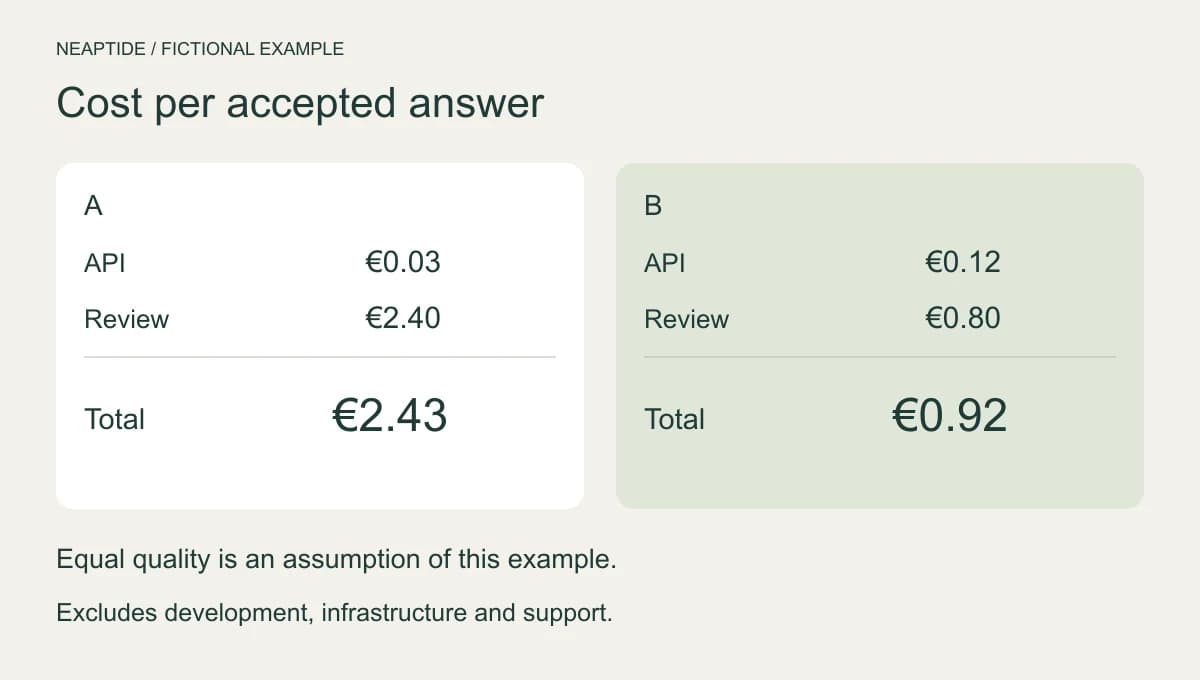
The $2.70 difference per thousand calls does not establish the cost of a thousand accepted answers. Measure corrections, rejections and retries on your own tasks. Record review time in the pilot before adding it to API costs.
The comparison leaves out development, hosting, storage, support and data preparation. Add those for the period you are assessing. And time saved does not automatically become cash saved: work out what the team would do with that time, or which expense would actually go down.
Measure the pilot by accepted work
Count completed, accepted tasks, not calls. Record system spend, review time, retries and the reasons answers were rejected. If 100 requests yield 70 usable results, divide the total cost by 70.
Microsoft’s guidance on delegating work to AI asks two questions: what happens if the output is wrong, and how easy is the mistake to spot. Build human review into the workflow and time it.
Include operation after launch
Budget for model use, infrastructure, knowledge updates, failure analysis and regression checks. A change to the instructions, an integration or the model may mean retesting scenarios that used to pass. Name the person who spots problems and the team that has the capacity to fix them.
Microsoft’s cost guidance asks for a cost model that covers initial and ongoing costs, then regular reviews of actual spending against it. Applied to an AI project, that keeps the work after the demonstration on the books.
Prepare a useful estimate request
Describe one workflow: how often the task comes up, who handles it, how long it takes and which errors would be unacceptable. Send sample inputs with identifying details removed and examples of good outputs. List the systems involved and the relevant documents, and name a subject expert who can answer questions.
With that in hand, a pilot discussion with Neaptide can be realistic: what to test first, what implementation includes and when to expand. A broad price range without these details helps far less than a clear scope.