Toy store SEO: 60% of tracked queries in the top 3 after one year
August 19, 2026 · 5 min read
An archived toy store SEO project with five ranking checks over 12 months. At the final check, 57 of 75 queries were in Yandex’s top 10, 45 in the top 3 and 27 at number one.
In this case study
This case comes from our archive: a regional children’s toy store. We worked on product categories, page structure and content, then tracked search rankings over a year. The company name and city are withheld, and the figures come from five original reports.
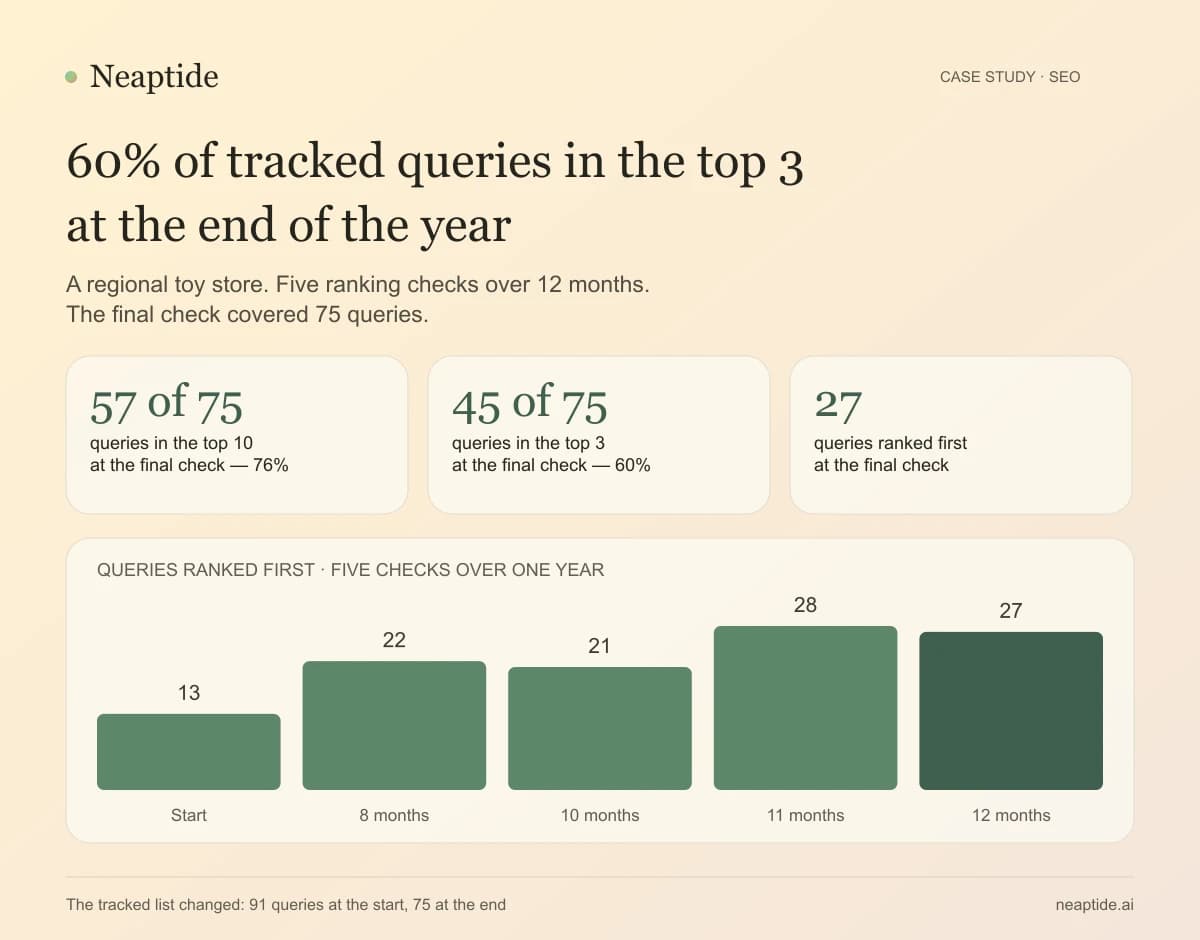
The initial rankings
At the start, 40 of 91 tracked queries were in Yandex’s top 10, including 13 at number one. The list covered product types and local searches, such as “wooden toys”, “board games”, “buy a plush bear” and “toy store in [city]”.
Category pages and product searches
We grouped queries by product type: wooden and plush toys, board games, construction sets, dolls and toys for younger children. Each group got its own category page with relevant content and a clear structure. After that we kept working on the pages and on external links.
Five checks over a year
- Start: 40 of 91 queries in Yandex's top 10, 13 at #1.
- 8 months in: 37 of 51 in the top 10, 22 at #1.
- 2 months later: 44 of 51 in the top 10, 34 in the top 3.
- A month later: 56 of 65 in the top 10, 42 in the top 3, 28 at #1.
- Final measurement (a year after the start): 57 of 75 in the top 10 (76%), 45 in the top 3 (60%), 27 at #1.
The five reports show rankings at specific dates. The tracked list changed from 91 queries at the start to 75 at the end, so each count and percentage has to be read against its own total. Nor do the reports show that every ranking held between checks.
At the final check, 45 of 75 queries were in the top 3 and 27 ranked first. Those figures describe the selected queries on that date, rather than every product search throughout the year.
What the data supports
The reports document strong Yandex rankings for the selected category queries. Google was more modest, with around 20 queries in the top 10. We cannot isolate the effect of each change from this data, and it does not show a sales increase. AI recommendations were not measured either.